
|
for Judges by Tamara Koyn. August 2016. | |||
| |||
|
For 2015 and 2016, three new Compulsory Sequences were introduced to the Artistic Events (outdoor), two for Freestyle Skydiving (FR) and one for Freeflying (FF). This article discusses details to consider when judging these three Compulsory Sequences. This article is a supplement to the 2014 article that discusses judging the Compulsory Sequences. If it's been awhile since you have last reviewed it's content, you should also review that article in addition to this article. Remember to look for any changes in the rules since that apply to those Compulsory Sequences. Discussion points do not offer definitive answers, but rather are designed to get judges thinking about judging these Compulsory Sequences in a fair manner. This discussion is designed to help enhance observation skills. (Not that every single defect in performance for each video clip is NOT discussed.) Judging the Open Stag Sequence (FR-1) Sample 1Sample 2 Sample 3 Sample 4 The rules state "The open stag position must be maintained, without any bend at the waist, during the 360 degree pirouette." In other words, Performers are required to maintain the straight leg inline with their torso. When head-down, this places the straight leg within the burble of the torso and container, thus it is more difficult to maintain balance. Additionally, the Performer's fallrate will be faster. Performers solve this issue by arching at least a little bit. The head-down open stag position looks very nice when performed with an arch (Sample 1 and Sample 4), however, the rules specify the straight leg must in line with the torso. If the Performer does not arch, they might bend the knee to place the foot outside the burble of the torso and container (Sample 2). In Sample 3, do you think the Performer better keeps the straight leg more inline with the torso? There is more to discuss...The description for the Open Stag Sequence (FR-1) is not thorough. In Sample 1, how many degrees of carving does the Videographer perform? Does your answer impact your score? If another Team performs identically to Sample 1 but the Videographer carves a full 360 degrees, do you give this other Team a better score than you would give to Sample 1? The rules state, "Videographer must make a synchronised carve around the performer in the opposite direction, while the 360¡ pirouette is performed." The amount of carving the Videographer must perform is not specified. If judges were to award more points to those Teams that show more carving, how do the Teams who perform less carving know that the Videographer is required to do more carving to earn a better score? Also, how much carving must the Videographer perform in order for the judges to recognize that the carving requirement has been met? Perhaps, you, as a judge, will expect to see at least 90 degrees of carving? Perhaps, if you see 45 degrees of carving and because the rules do not specify a minimum amount of carving required, you will still give some credit for carving to be fair to the Team?In Sample 1, does the Performer pirouette more or less than 360 degrees? When the Videographer carves less than 360 degrees, you will see the Performer's side less than four times (excluding the start of the Pirouette) when the Performer Pirouettes exactly a full 360 degrees. You must watch the Performer's pirouette closely with respect to ground references to see if it is at least 360 degrees. By watching the ground references, how much does the Videographer carve and how much does the Performer pirouette? Or, do you apply the principle of turning intent from Formation Skydiving to determine how much the Performer pirouetted? Excluding the start, you do see the Performer's side four times in Sample 1! While the amount of carving is not specified, the rules do state that the carving must be synchronised, meaning that the Videographer is carving at the same time the Performer makes a 360 degree pirouette. In Sample 2, the Videographer is not synchronised with the Performer's pirouette. Do you recognize when the Videographer's carving motions are oval rather than round? Watch Sample 3 and Sample 1. During oval carving, the distance to the Performer changes rather than remaining constant...in other words, the Performer is growing larger and smaller in the frame during the carve. The definition for the Open Stag position (Addendum B B-6) only specifies that the lower leg of the bent leg is parallel with the upper leg (thigh) of the straight leg as shown in Sample 3 and Sample 4. In Sample 1, the lower leg of the bent leg is not parallel with the thigh of the straight leg. (Note that the rules do not specify the degree of hip flexion...in other words, the knee of the bent leg is not required to be level with the hip.) Some of the Compulsory Sequence do have a requirement for the orientation of the video image. For FR-1, is there a requirement for the orientation of the video image? Watch Sample 1 and Sample 3. If there were no other differences in performance, does the orientation of the video image effect the score you give? If yes, how will the Teams know? Judging the Angle Sequence (FR-6) Sample 1Sample 2 Sample 3 Sample 4 Sample 5 Sample 6 While the Performer rolls, the Videographer is required to carve in such a manner as to always be showing the side of the Performer with only the background scenery moving. This is not easy to accomplish. Typically, as shown in Sample 1, the Performer suddenly makes a half roll and the Videographer then can not keep up with the side of the performer when carving. The Performer is facing downward before the Videographer reaches the ending position. In attempt to solve this problem, some Videographers do not begin on level with the performer (and fail to show the horizon approximately 45 degrees at the start). As seen in Sample 2, when the Performer rolls, the Videographer catches the Performer's side and carves in sync to the ending position. Does this technique earn a better or worse score than a Team who more clearly shows the start position? Or, is it about the same? Compare Sample 2 and Sample 3. Does a Team (Sample 4) have potential to earn a better score when the Performer makes an effort to roll more slowly, permitting the Videographer to be able to carve in sync, even if the body form is poorer? Sometimes the Performer shows very good body form, but the Videographer has not meet their requirements. And for other Teams, the Performer's body position is less ideal but the overall "mechanics" of the Compulsory Sequence are better performed. For example, one Team shows excellent body form but a roll too quick for the Videographer to keep up where the Performer of another Team rolls more slowly (but with poorer body form) so the Videographer can stay synchronized during the carving. Do you give a better score to the former or the later? The Videographer's carving should be revolving about the Performer's Head-Tail axis. However, sometimes the Videographer carves about an axis perpendicular to the ground, as seen in Sample 5. Also, in this sample, does the Performer roll, or is the Performer carving? Do you consider Sample 6 to be the best performed Angle Sequence? Why or why not? As you read about FF-5 next, you will see additional discussion points that may apply to FR-6. Judging the Angle Carve (FF-5) Sample 1Sample 2 Sample 3 Sample 4 The rules state "Videographer must simultaneously carve 180 degrees going under the Performers in the opposite direction and end on the opposite side of the Performers' centre point." Watch Sample 1 and Sample 2. In which of these two samples did the Team attempt to follow the description of this Compulsory Sequence more closely? In Sample 2, the Videographer attempts to carve about the Performers' angled flight, going under the Performers. Note that the rules do not require showing a static start position. When you see sky behind the Performers, the Performers are above the Videographer. (Unfortunately, in addition to other quality issues, the Performers rush to their next maneuver too quickly!) Sample 1 exhibits good form, but does it follow the description of this Compulsory Sequence? Does the Videographer pass under the Performers? Or, do you see the horizon for the entire carve? Also, do you see the horizon at approximately 45 degrees at the start and the end? (The Videographer needs to tip his head as necessary to show the horizon at 45 degrees.) The IPC rules allow Videographers to show the Performers appearing nearly horizontal or nearly vertical in the video frame at the start and at the end. Both of the following images showing the horizon at approximately 45 degree angle and the Performers about 45 degrees head low (with respect to the horizon line) are acceptable for the start and the end. 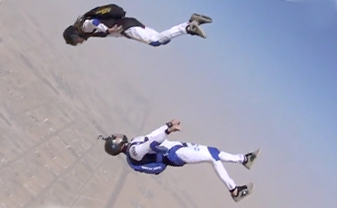 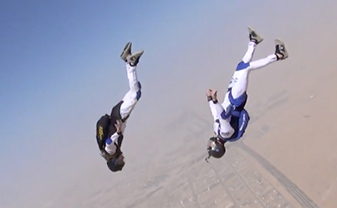 To make it more clear and more intuitive that the Videographer should pass "under" the Performers while carving about their angled flight, the USPA competition rules also require the Performers to appear nearly vertical in the video frame. Thus, only the second image with the Performers appearing nearly vertical is acceptable at a USPA competition. In Sample 3, do the Performers carve in an approximately 45 degree diagonal orientation with their heads low? Or, are they nearly completely vertical? How much do you deduct from their score? In Sample 4, did the Videographer carve? Is the background scenery the same at the end of the Compulsory Sequence as it was at the start? Is the Videographer high? How much does this reduce your score? Are you able to confirm that the required Layout position was shown by the bottom Performer at the start? | |||
|